Best Online Learning Platforms for Business (2026)


Choosing the right platform is a business decision.
Most online learning platforms look the same at first glance: thousands of courses, clean dashboards, and long feature lists.
But that’s not where the real difference lies.
Instead, it comes down to whether your people:
- Use the platform
- Complete what they start
- Change how they work as a result
Because if they don’t, your return on investment doesn’t deliver. This guide helps you choose the right platform faster.
Who this is for:
- L&D managers building scalable development strategies
- HR teams evaluating vendors
- Organisations replacing underused learning platforms
What you’ll get:
- A side-by-side comparison of the best platforms
- Clear “best for” guidance
- Honest strengths and trade-offs
- A faster path to a confident shortlist
What is an online learning platform for business?
An online learning platform for business is an end-to-end system that combines digital training content with the technology to deliver, track, and manage it, all within a single solution designed for teams and organisations.
This is a meaningful distinction from pure eLearning content providers, which supply courses and videos but expect you to handle delivery through your own LMS.
An online learning platform brings the content and the experience together: structured learning paths, analytics, mobile access, SSO integration, and manager dashboards, not just a library you have to curate and host yourself.
For L&D teams, this distinction matters when evaluating vendors. If you are looking for a bolt-on content library to plug into an existing system, a content provider may be sufficient.
If you are looking for a scalable, managed development solution for your workforce, a platform is what you need.
Best online learning platforms for business at a glance
G2 ratings sourced from g2.com (2026). Pricing is custom-quoted for all enterprise providers, contact directly for quotes.
How to choose the right online learning platform
Before comparing features, get clear on this:
What problem are you actually trying to solve?
Because different platforms are built for very different outcomes.
Consider engagement
Most platforms fail here.
If employees don’t use it, nothing else matters.
Look for:
- Strong storytelling and formats
- Short, practical learning experiences
- High completion rates
Consider skills gaps
Match platform depth to your priority:
- Human skills → GoodHabitz
- Technical skills → Pluralsight
- Academic credentials → Coursera
- Compliance → Skillsoft / OpenSesame
Trying to force one platform to do everything usually fails.
Consider scale
Check:
- Pricing model (per seat vs flat rate)
- Multilingual support
- Rollout complexity
Consider measurable impact
Look beyond “courses available” and ask:
- Can you track engagement meaningfully?
- Are there structured learning paths?
- Does it support behaviour change, not just content consumption?
The best online learning platforms for business (reviewed)
GoodHabitz
Best for: Organisations focused on human skills development at scale
Overview
GoodHabitz takes a fundamentally different approach to corporate learning.
Rather than building the biggest catalogue, the platform focuses specifically on the skills that shape how people work together and wraps them in content that employees genuinely want to engage with.
For instance:
- Communication
- Resilience
- Self-leadership
- Growth mindset
- Wellbeing
- Professional effectiveness
Key features
- 250+ courses across human skills, wellbeing, leadership, and professional effectiveness
- Multiple learning formats per course: bite-sized activities, full lessons, psychometric assessments, and team exercises
- Talentscan: a self-assessment tool that matches learners to the courses most relevant to them
- Structured learning journeys -not just open-access libraries -to guide employee development
- Content localised in 20+ languages with genuine cultural adaptation for global rollouts
- L&D dashboard: track engagement, completion, and content popularity across the organisation
- Flexible LMS/LXP integration with SSO support
Pros and cons
Pros
- Exceptionally high engagement rates versus traditional eLearning benchmarks
- All content produced in-house -consistently high quality across the library
- Designed for behaviour change, not just knowledge transfer
- Flat-rate pricing provides budget certainty at scale
- 20+ languages with cultural adaptation, not just translation
- Fast implementation and dedicated success coaches included
Cons
- Narrower catalogue than aggregator platforms -focused on human and professional skills, not deep technical or compliance content
- Organisations needing specialist IT certification or regulatory compliance training may need to combine with a specialist provider
What users say
"The variety of courses on offer is impressive and covers a wide range of topics -from personal development to professional skills. The courses are very well structured, visually appealing and entertaining, which makes learning really enjoyable. There are many interactive elements that make learning even more interesting." -Sabrina S., HR Manager · G2
"Huge library, different topics to improve soft skills - Different type of learning with various media - Content is available in different languages and they publish periodically new courses - Content is not also created specific for a language but also region (German content separately for Germany, Austria and Switzerland in their idiom) - Marketing campaign are ready to use and can be created on their platform - GoodHabitz events with other companies to share experience - easy to use from anywhere - Great GoodHabitz coaches to support for implementation and marketing campaign." - Aysegül I., L&D Specialist
Linkedin Learning
Best for: Broad professional skills and self-directed learning
Overview
LinkedIn Learning benefits from the world's largest professional network sitting underneath it. The catalogue spans 23,000+ courses across business, technology, and creative skills, and the platform's ability to surface personalised recommendations based on a learner's LinkedIn profile is genuinely useful for self-directed professionals.
Key features
- 23,000+ expert-led courses across business, technology, and creative skills
- AI-powered coaching and personalised recommendations based on LinkedIn career data
- Next Role Explorer and skills gap analysis for individual career development
- AI-powered roleplay for practising soft skills in realistic scenarios
- Seamless integration with Microsoft Teams and major LMS platforms
- Professional certificates that appear directly on LinkedIn profiles
Pros and cons
Pros
- Vast library covering virtually every professional development area
- Deep personalisation informed by real career and job market data
- Certificates add directly to LinkedIn profiles -motivating for career-focused learners
- Excellent Microsoft 365 integration for organisations in that ecosystem
- Strong AI-powered course recommendations and skill gap tools
Cons
- Some content can feel dated, particularly in fast-moving technical areas
- Less suited to structured, manager-led development programmes at organisation level
- The sheer volume of content can overwhelm learners without internal curation
- Best value realised when already invested in the LinkedIn/Microsoft ecosystem
What users say
LinkedIn Learning has been my go-to platform for brushing up on skills and exploring new ones. I really appreciate how easy it is to dive into a topic—even if I just have 15–20 minutes. Some of the content feels a little basic or outdated, especially for more technical topics. Also, the search results can sometimes be overwhelming or not very accurate. – Joselyn M., Solution Engineer
What stands out most for me is the seamless integration with the LinkedIn professional network. This platform delivers highly personalized course recommendations that are tailored to my specific career objectives. The biggest drawback is the limited interactivity, especially considering the high price if you don't have a premium LinkedIn account. Most courses consist of passive video lectures, and I would prefer to see more opportunities for hands-on practice or integrated coding environments. - Andrea C, Photographer
Udemy Business
Best for: Fast-moving teams with broad or niche skills needs
Overview
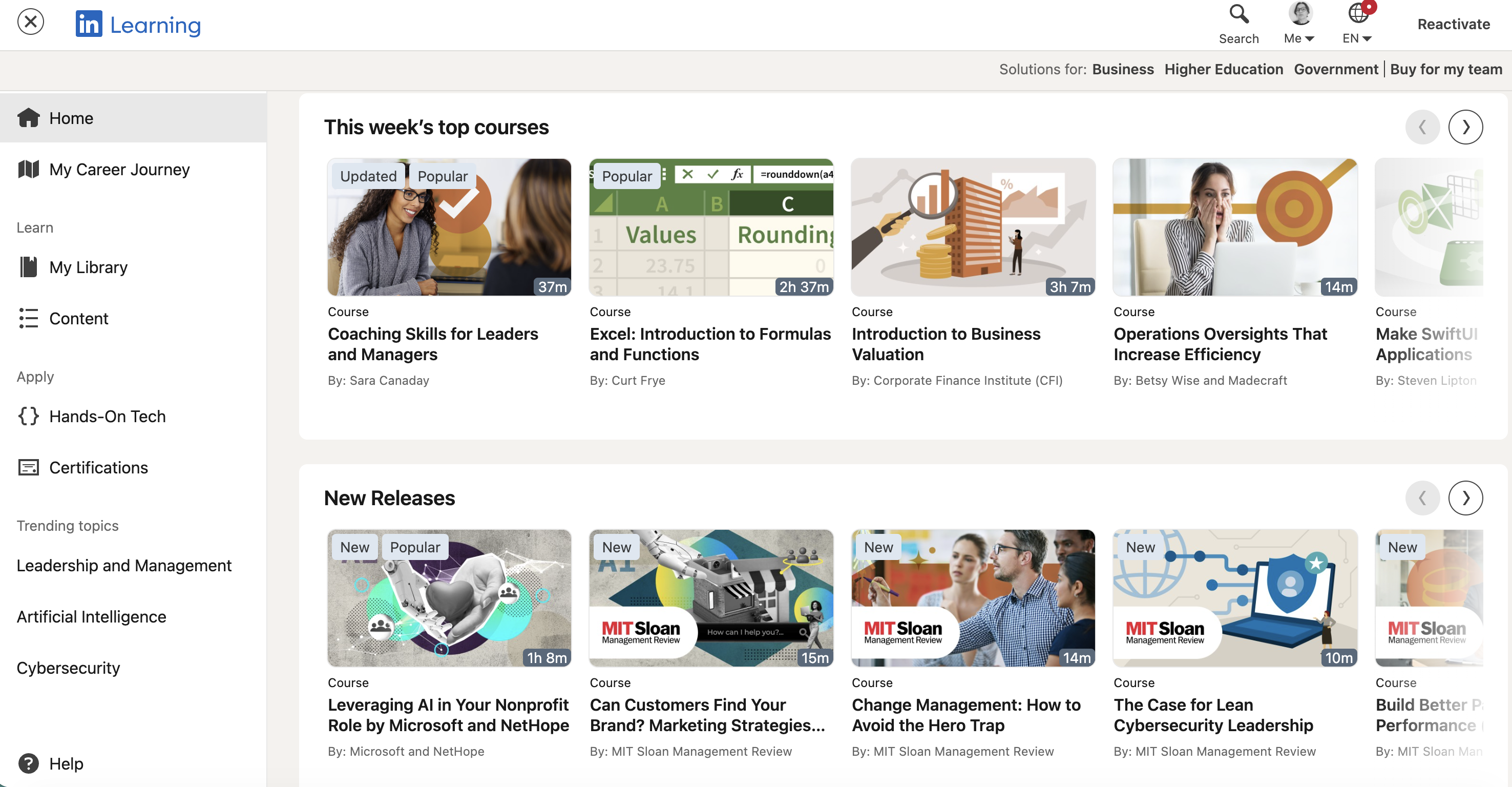
Udemy Business offers an enormous and affordable catalogue built around content from expert practitioners and instructors.
With over 210,000+ courses in total and 16,000 curated courses for business use - the breadth is unmatched.
Speed is another genuine differentiator: new courses on emerging topics appear on Udemy before most other platforms, making it valuable for organisations that need to stay ahead of fast-moving skill areas.
Key features
- 210,000+ courses total; 16,000+ curated for business use
- Custom learning paths built by L&D teams for specific roles or objectives
- Mobile and offline access for remote and on-the-go employees
- Analytics dashboard: enrolments, completions, and engagement tracking
- Rapid content updates as new skills and trending topics emerge
Pros and cons
Pros
- Catalogue breadth - something for virtually every role and skill need
- Trending topics and niche skills added faster than any other platform
- Strong mobile experience for distributed and remote teams
- Highly flexible and self-paced -works well for motivated, autonomous learners
Cons
- Quality varies significantly beyond the curated top-tier content
- Content can feel generic for complex, role-specific professional development
- Requires active internal curation to prevent learner overwhelm
- Less suited to structured, organisation-led programmes with consistent standards
What users say
Udemy Business is unique in that it emphasizes skills that are applicable to the workplace rather than just academic material. Learning feels practical and inspiring because the courses are simple to follow and made to be used right away at work. The variance in course quality is the primary disadvantage. Some courses feel very polished, while others feel less structured or out of date because the content is created by different instructors. - Sabri S., Trainer in consulting
What I like most about Udemy Business is how practical it is, allowing me to immediately apply the learning to real-life situations. One area where Udemy Business could improve is content consistency. Since courses are created by different instructors, the depth, teaching style, and quality can vary. While there are many excellent courses, it sometimes takes extra time to find the one that matches the exact level or learning approach we are looking for. - Vinay P., Mechanical design Engineer
Coursera for Business
Best for: Academic and technical upskilling with formal credentials
Overview
Coursera for Business brings university-level rigour to corporate L&D, partnering with institutions like Stanford, Yale, the University of Michigan, Google, and IBM to deliver accredited courses and certificates. For organisations where formal credentials matter, particularly in data science, AI, digital transformation, and technical domains, it is a compelling choice.
Key features
- University-endorsed certificates, specialisations, and pathways toward accredited degrees
- Courses co-created with Google, IBM, Meta, Stanford, Yale, and other leading institutions
- Skill tracking and personalised learning path recommendations
- Enterprise analytics: enrolments, completions, skill scores, and engagement
- Capstone projects and peer-reviewed assignments for applied, project-based learning
Pros and cons
Pros
- Credible, career-boosting certifications from world-recognised institutions
- Market-leading for data science, AI, cloud computing, and advanced technical skills
- Structured pathways support accountability and completion
- Strong employer brand recognition -motivating for talent retention and attraction
Cons
- Course length demands significant time investment -difficult for busy employees to maintain
- Less effective as a company-wide, consistent development programme
- Higher cost for degree-level and specialisation content
- Narrower focus -less suited to soft skills or broad professional development
What users say
I like the wide variety of courses available on Coursera for Business, as there's always something for everyone, which fits many people's needs. I wish there was more way to preview a course before enrolling or having to read something long. Maybe a better way to show objectives. - Olivia M., Impact coordinator
I like that I can further my skillset at my own timeline and pace. The learning model is forgiving and I feel encouraged to learn. It was easy to implement for the team, but the length of the classes can sometimes be tedious for working professionals. - Annie N., Data and intake coordinator
Skillsoft
Best for: Large enterprises needing extensive libraries and compliance coverage
Overview
Skillsoft has been a dominant name in corporate eLearning for decades, and its Percipio platform represents a meaningful evolution from its predecessors, offering personalised learning paths, AI-powered features, and 500+ curated learning channels across compliance, technology, leadership, and business skills.
Key features
- Enterprise-grade compliance modules with audit-ready completion tracking
- Leadership development tracks for every level -new managers through to senior executives
- Hands-on IT practice labs for cloud (AWS, Azure), cybersecurity, and data science roles
- Large eBook and audiobook library for self-directed learning
- Micro-learning modules for just-in-time, performance-support skill-building
Pros and cons
Pros
- Best-in-class compliance coverage across multiple regulatory frameworks and global regions
- Percipio platform offers solid personalised learning paths and analytics
- Hands-on labs provide genuine technical practice, not just conceptual content
- Highly rated customer support team
Cons
- Admin interface consistently cited by users as unintuitive and complex
- Some role-play and scenario-based content feels less engaging than the broader library
- Volume of content can overwhelm learners without strong internal curation
- Less effective for organisations prioritising engagement-led culture change
What users say
We saw a wide variety of learning modules, videos, reading, and other opportunities to easily incorporate into learning packages for our users. We always saw new and exciting learnings being added, and if something was to be retired, we received plenty of notice - Katie M., eLearning Production and Deployment Specialist · G2
The app is amicable and has everything one need to for training and making lessons to new hires or employees so they can learn new information on an easy way. Percipio is limited in the training part, it shows you everything and all your lessons to do and gives you reminders, but once you finish with that, there's not much to do on the platform as a user. – Carlos Miguel D., Customer representative
Pluralsight
Best for: Technical and developer teams building deep technology capability
Overview
Pluralsight is the specialist's choice for technology skills. Its catalogue goes deep in software development, cloud infrastructure, cybersecurity, and data engineering -with detailed learning paths, built-in skill assessments, hands-on labs, and role-based journeys that make it genuinely useful for engineering and IT teams trying to measure and grow technical capability.
Key features
- Market-leading depth in cloud, cybersecurity, software development, and data engineering
- Skill IQ assessments and Role IQ gap analysis for objective capability measurement
- Hands-on labs and sandboxes for real-world technical practice in safe environments
- Role-based learning paths that map content to specific engineering and IT roles
Pros and cons
Pros
- Depth in technology, cloud, cybersecurity, and developer skills
- Skill IQ and Role IQ provide objective capability measurement -rare in the market
- Hands-on labs deliver genuine practice, not just passive watching
- Strong analytical tools for engineering managers tracking team capability
Cons
- Depth drops sharply outside core technology domains
- Some content is slow to update as specific technologies evolve
- Not a standalone solution for broader, company-wide L&D needs
- Pricing can be high relative to breadth for non-technical skill coverage
What users say
I like that Pluralsight offers high‑quality, expert‑led tech courses with structured learning paths and powerful skill assessments like Skill IQ and Role IQ. Some courses can become outdated over time, and the UI can feel clunky for certain users. Others note that pricing may feel high. - Ayush S., Client manager
I like the hands-on labs the most, as they make it easy to practice real cloud scenarios instead of just watching videos. The courses are well-structured and explained clearly, which helps in understanding complex cloud concepts quickly. Some advanced topics could go deeper, especially for experienced users. Also, a few labs feel overly guided, which limits room for exploration and problem-solving. - Verified User in Computer Software
Go1
Best for: Organisations needing aggregated breadth from multiple content providers
Overview
Go1's model is aggregation rather than production. It brings together content from over 250 providers into a single platform, giving organisations access to enormous topic breadth through one commercial relationship rather than managing multiple vendor contracts.
Key features
- 250+ content partners in a single aggregated platform
- Broad topic coverage across virtually every professional skill domain
- Single commercial relationship simplifies procurement and vendor management
- LMS and LXP integrations to plug into existing tech stacks
Pros and cons
Pros
- Vaste content breadth through aggregation of 250+ providers
- One contract and one platform reduces procurement and admin complexity
- Highly flexible -suitable for organisations with very diverse training needs
Cons
- Content quality is inherently inconsistent across different providers and topics
- Learner experience can feel fragmented when navigating content from different sources
- Less suitable where engagement, experience quality, and consistent tone are strategic priorities
- Requires significant internal curation effort to realise full value
What users say
It’s a solid platform that supports scalable learning across diverse teams, with responsive support that’s always been quick to assist — and that’s truly appreciated. Some content can feel too generic or repetitive, and the search functionality could be more intuitive and refined — finding specific content can sometimes be more time-consuming than expected. - Verified User in Consulting
I appreciate Go1's comprehensive compliance offerings, which are crucial for our geographically diverse organization. The setup is easy and straightforward, especially given its integration with our LMS. Some of the tech courses on programming are not the latest versions on Go1. This is particularly frustrating when equipped with developers eager to access the most current content. - Peter E., Head of Learning and Development
OpenSesame
Best for: Compliance, safety, and DEI-focused content at scale
Overview
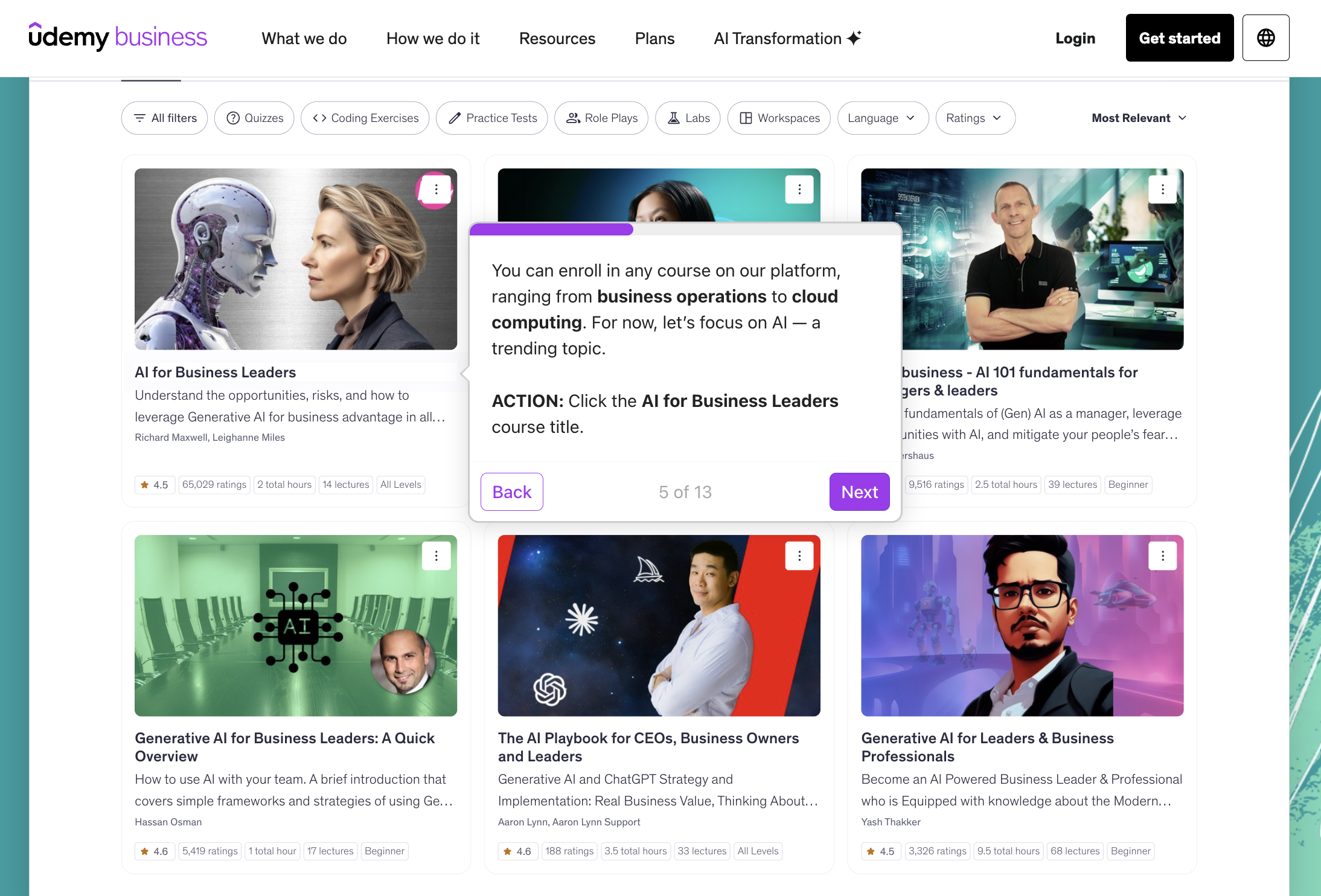
OpenSesame is a curated content marketplace with 40,000+ courses from a vetted network of publishers, covering business skills, compliance, safety, technology, certifications, DEI, and wellness across 70+ languages. Unlike open aggregators, OpenSesame selects its publishers rather than accepting all comers, and every course passes a 39-point quality review before being listed.
Key features
- 40,000+ curated courses across business, compliance, safety, DEI, and wellness
- Vetted publisher network -every course passes a 39-point quality review
- Content available in 70+ languages
- Strong depth in compliance, workplace safety, and DEI training
- Dedicated account management and highly rated customer success team
Pros and cons
Pros
- Strong user satisfaction
- Rigorous content curation process means more consistent quality than pure aggregators
- Exceptional depth in compliance, safety, and DEI content
- 70+ languages -broad international coverage
- Highly rated customer support and account management
Cons
- Search and navigation interface cited by multiple users as difficult to use
- Less depth in specialist technical software and developer skills
- Requires internal curation effort to make the catalogue navigable for learners
What users say
I use OpenSesame for curating course material and it does a great job of making learning fun and engaging. It provides opportunities to showcase different ways to bring new content to our organization, helping maintain a high learning culture and keeping things fresh. However, a lot of the courses in OpenSesame have the same exact titles, which doesn't seem appealing to learners. - Erin S., Manager of Learning and Development
What I like most about OpenSesame is how easy it is to find high-quality courses on just about any topic without having to build everything from scratch. The variety is great, but some courses can also feel a little generic if you’re looking for something very specific to your company or industry. One downside is that with so many courses available, it can sometimes take a bit of digging to find the ones that really fit your audience. - Verified User in Retail
Learning Pool
Best for: Organisations needing a full-suite platform with custom content capabilities
Overview
Learning Pool is one of the UK's largest end-to-end learning providers, combining an LMS, LXP, off-the-shelf content library, and custom content development under one roof. That breadth is its core proposition: organisations can access a complete learning infrastructure through a single vendor relationship rather than managing multiple suppliers.
Key features
- Full-suite provider: LMS, LXP, off-the-shelf content library, and custom content development
- Particularly strong in safeguarding, data protection, and health and safety compliance content
- Award-winning AI Conversations tool for practising challenging workplace conversations
- Strong presence and deep expertise in UK public sector and regulated industries
- Custom content development for highly specific training needs
Pros and cons
Pros
- Genuine end-to-end solution -LMS, LXP, catalogue, and custom content in one relationship
- Market-leading for UK public sector, safeguarding, and compliance-driven organisations
- Award-winning AI-powered leadership and skills practice tools
- Reduces vendor fragmentation for complex L&D operations
Cons
- Off-the-shelf catalogue breadth is smaller than pure-play library providers
- Custom content development adds significant cost and project lead time
- May be more platform complexity than smaller or simpler organisations need
What users say
The customisations possible and the theming and branding capabilities work very well for us. We have complete control over who sees what and this is incredibly important. the experience feels a little dated, and the user experience suffers sometimes as a result. You often have to work very hard from an administrative/design perspective to achieve what you want. - Samuel D., IT Trainer
The customer support team for technical issues are incredibly responsive, often response received within the same day. The downside is that the UI of the platform isn’t great, could do with more customisability, as currently restricted in what we can design. - Furqan Z., L&D Manager
CrossKnowledge
Best for: Leadership pipeline and management development programmes
Overview
CrossKnowledge specialises in leadership and management development, with a faculty drawn from top business schools, Thinkers50 contributors, and recognised academic experts. The content is credible, research-backed, and structured around real leadership frameworks -making it a strong choice for organisations with a specific mandate to develop their management pipeline.
Key features
- Research-backed leadership and management content with strong academic credibility
- Faculty includes business school professors, Thinkers50 contributors, and expert practitioners
- Blended learning capabilities for structured cohort-based programmes
- Global reach across 130+ countries with multilingual content
Pros and cons
Pros
- Academically grounded leadership and management content
- Strong faculty -business school professors and recognised thought leaders
- Blended learning design suits structured leadership development programmes
- Global reach and multilingual content for international organisations
Cons
- Narrow focus -less relevant for organisations needing broad skills coverage
- Platform complexity requires significant admin effort to configure and manage
- Pricing cited as high relative to volume of content included
- Lower G2 score than comparable platforms suggests UX friction for some users
What users say
Seamless user experience, but not intuitive, and took a lot of time for making similar content pages” -Verified G2 user in Pharmaceutical
I’ve particularly liked the ease of each course, but it doesn’t work well on mobile devices like iPad -Verified G2 user in Retail
How these platforms differ, and why it matters
Listing features is easy. Understanding what the differences mean for your organisation is harder. Here are the dimensions that matter most when building a shortlist.
Depth vs breadth
Platforms like LinkedIn Learning and Go1 compete on volume with thousands of courses across hundreds of topics.
That sounds powerful, but it often creates noise. Large libraries can overwhelm learners rather than guide them.
Specialists like Pluralsight (tech) or CrossKnowledge (leadership) go deep instead. More relevant, but narrower.
GoodHabitz sits in between: focused depth in human skills, without trying to cover everything.
Engagement vs volume
More content doesn’t solve low completion rates. Engagement does.
Platforms that prioritise the following elements, consistently outperform those built around catalogue size:
- Storytelling
- Real-world scenarios
- Varied formats
The difference shows up in one metric: whether people actually finish what they start.
Guided journeys vs self-directed libraries
Some platforms offer a library and leave learners to figure it out.
Others guide them:
- Structured learning paths
- Role-based programmes
- Manager-led assignments
Guided platforms typically drive more consistent outcomes, especially at scale.\
Off-the-shelf vs custom content
Custom content feels tailored, but it’s:
- Expensive
- Slow to produce
- Quick to become outdated
For most organisations, high-quality off-the-shelf content delivers better ROI.
Custom only makes sense where content must be highly specific (e.g. compliance or internal processes).
Choosing a platform is about impact, not volume
The conversation about online learning platforms too often gets stuck on numbers: how many courses, how many topics, how many integrations.
These are useful data points, but they are not the right question.
The right questions are:
- Will this platform actually change something?
- Will your employees engage with it?
- Will it translate into different behaviours on the job?
- Will your managers be able to see the difference it has made?
Content is only valuable if it drives behaviour change. A library of 10,000 courses that nobody finishes is worth less than 500 courses that people complete, enjoy, and apply.
Engagement is not a nice-to-have -it is the precondition for any learning to work at all.
As you evaluate your options, hold onto this: the best platform is not the one with the most content. It is the one your employees want to use, and that moves the needle on how they work.
Ready to see what a platform built for engagement looks like?
GoodHabitz helps organisations build the human skills that drive real performance -through content your people will actually want to engage with. Whether you are starting fresh or looking to replace a library that is not working, we would love to show you what great learning looks like.
→ Browse the learning catalogue
Frequently asked questions
What is the best online learning platform for business?
There is no single best platform -the right choice depends on your organisation's development priorities, team size, tech stack, and budget structure. For engagement-led human skills development at scale, GoodHabitz consistently leads. For technical upskilling, Pluralsight is the specialist choice. For breadth and variety, Udemy Business or Go1. For formal credentials, Coursera. For compliance, Skillsoft or OpenSesame.
What is the difference between an online learning platform and an eLearning content provider?
An eLearning content provider supplies the training material - courses, videos, and modules - but expects you to handle delivery and tracking through your own LMS. An online learning platform combines content with the full delivery technology: analytics, mobile access, SSO, learning paths, and manager dashboards. Most platforms reviewed here are end-to-end solutions rather than pure content plays.
What should companies look for in an online learning platform?
Start with learner engagement and completion rates - a platform that employees do not use delivers zero ROI. Then assess content quality and relevance to your organisation's development priorities, multilingual support for global teams, integration with your existing HR and LMS tech stack, and whether the pricing model scales affordably as headcount grows.
Which platform is best for a global organisation?
GoodHabitz offers the strongest multilingual coverage for human and professional skills, with content in 20+ languages with genuine cultural adaptation rather than direct translation. LinkedIn Learning covers 24 languages. OpenSesame supports 70+ languages. For technical content, Coursera and Udemy Business have broad language options but less cultural localisation.
How many online learning platforms should an organisation use?
Many organisations operate two platforms in parallel -a broad human skills platform for company-wide development, and a specialist platform for technical, compliance, or role-specific content. The key is ensuring the learner experience remains coherent. Too many platforms create fragmentation and reduce overall engagement, so consolidation to two or three well-chosen solutions typically delivers better outcomes than a sprawling multi-vendor approach.
What are human skills and why do they matter?
Human skills, also called soft skills or power skills, include communication, collaboration, resilience, adaptability, leadership, and emotional intelligence. Research consistently identifies these as among the strongest predictors of individual and organisational performance. As automation and AI reshape work, human skills are increasingly the differentiator that technology cannot replicate -which is why specialised platforms like GoodHabitz focus on them exclusively.
Roberta is a multilingual marketing professional with over 10 years of experience across marketing, PR, and customer engagement, built on a foundation in journalism, and a passion for storytelling.